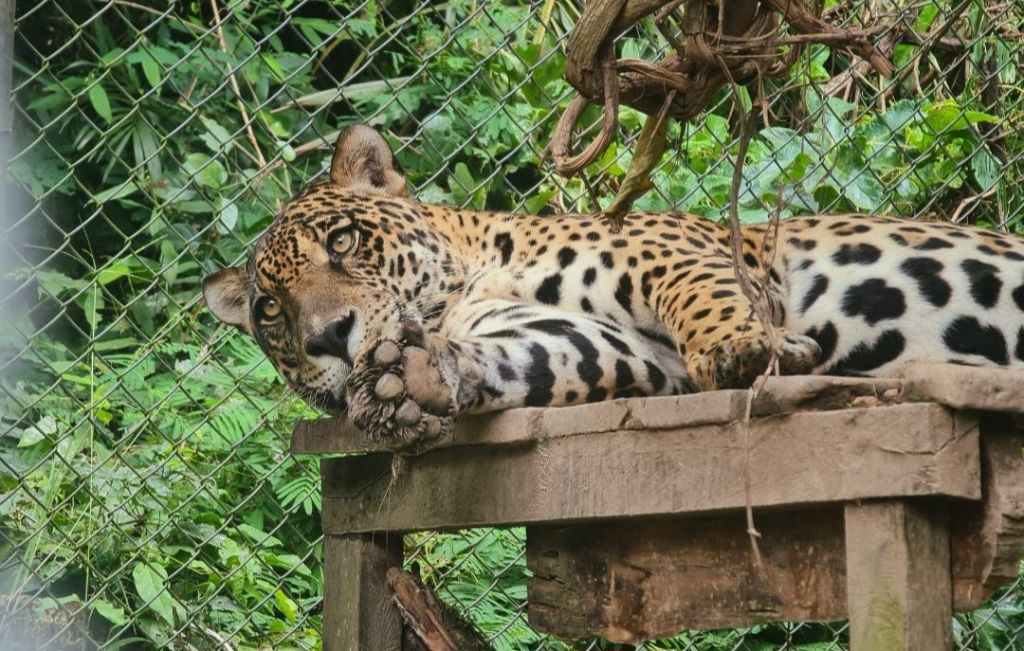
Kusiy is a male jaguar. It is understood that his mother was poached for fur to be sold on the black market. Kusiy, still a cub at the time, then spent his early life living in poor conditions in a backyard, with other animals, such as poultry and dogs. He had flees and had lost a lot of fur through excessive scratching. The neighbours called the authorities and he was taken to the charity. He was treated for a trauma to his left eye which had nearly left him completely blind, as well as intestinal parasites. He was transferred to this current park back in 2015, where he had the fortune of having my good friend Sam as his volunteer.
Marine and I walk up to the enclosure and Kusiy is waiting. He rubs his head against the fencing, as means of initiating affection. Marine is then able to give him a few scratches and say hello. I stand behind, as not to overstep my mark. This is his home and I am currently a stranger. As was the case when meeting Ru nine years ago, I find myself very impressed at his enclosure – a hexagonal structure with each side spanning 30 metres. There is no roof which means that plants and trees grow everywhere. He has plenty of spaces to walk, run, jump and climb and the ability to find some privacy should he ever wish to. Marine and I start strolling around the perimeter, with Kusiy next to us, on the other side of the fencing. I am impressed with his pace. Ru was always more lethargic, strolling with a gentle, soft rhythm. Kusiy walks like he has places to be, and Marine and I struggle to keep up with him as we squelch through the muddy path lining the exterior. After some time, he slows and initiates more affection. This time, I slowly present my arm, giving him the option to engage if he wishes to. He takes a sniff and begins licking me. I didn’t shower yesterday, so I can imagine that I taste really good. He spends an extended period of time savouring the flavours before I switch arm. I had forgotten how sharp the tongue of a large cat feels. It’s like sand paper. At least he is scratching my mosquito bites for me. Speaking of which, the air is dense with them in this boggy land that lies deeper in the jungle. If you look away from your hand for ten seconds and look bag again, you will find at least five of them tucking into your tasty blood. This is why everyone was covered from head to toe when I arrived yesterday. I knew wet season was going to be tough, but nothing could have prepared me for this number of mozzies.
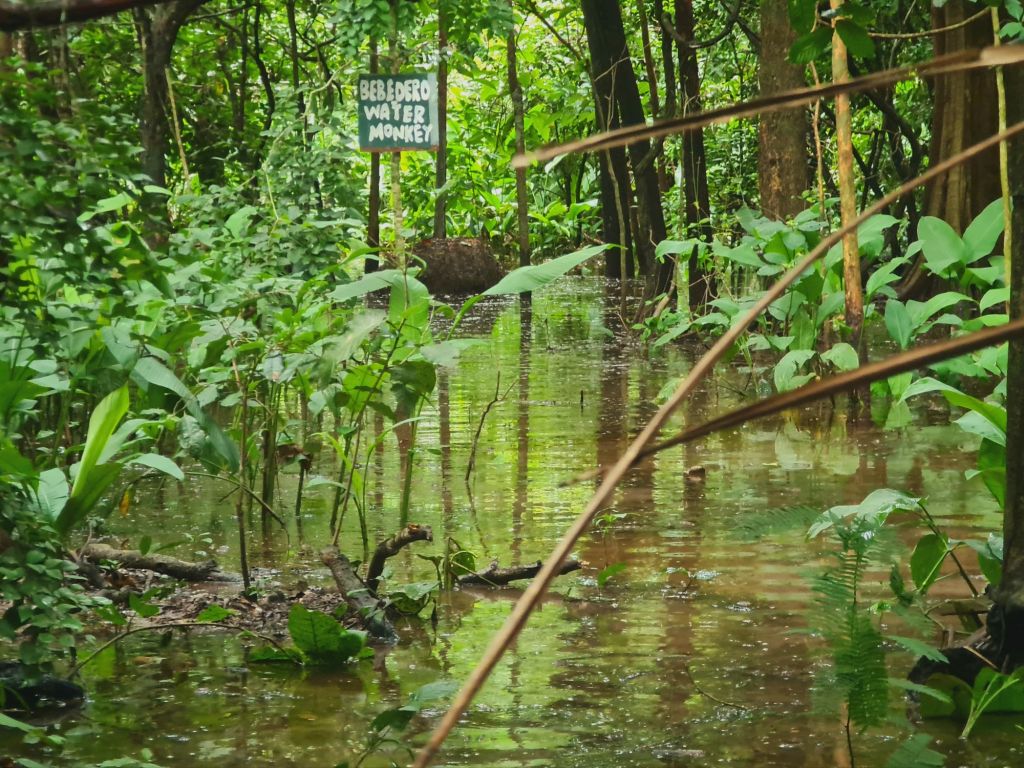
Following a couple of hours with Kusiy, Marine and I invite him into his management cage and close him in so that we can check on his main enclosure. We then proceed with our end of day tasks, including changing his water, fluffing his hay, cleaning up any poop or remaining bones and then finally hiding his food around. In the wild, he would need to hunt for his food. Something we can do to encourage him to keep using his sense of smell and general jaguar-ness is to hide food parcels around for him to sniff for. This is done by wrapping his meat up in patujú leaves and putting it in places for him to find. Marine is Belgian and doesn’t speak much English, but I enjoy working with her. She has a calming presence and clearly loves Kusiy. Once we have wrapped up our tasks, we then begin the long walk back to camp, slogging our way through the swampy forest. I finally take a shower and convene with the other volunteers in the Comedor. Tonight, we are heading into Santa Maria. This is a tradition that lives on. Nine years ago, we would do this once a week after dinner. We’d travel in shifts in the back of the park’s pick-up truck, singing along as we did so. We’d then have an evening enjoying cold drinks and a change of scene as we listened to 90’s classics on the jukebox. I had hoped that the songs hadn’t been updated, but was sorry to learn last night that where we are going is somewhere different. Furthermore, I am even more disheartened to discover that with the camp’s now present phone signal, we don’t use the pick up truck anymore; we call a taxi that takes the form of a minibus.
The taxi arrives and fifteen of us squeeze in and hit the road. The journey isn’t long and we quickly arrive in Santa Maria. There is a large table set out for us and a local standing by who has prepared a vegan, veggie and meat lasagne. We move in shifts to a local shop to pick up beer and other drinks. It’s a funny sort of shop. It feels more like a mini garage with a large fridge in it. I realise how bad my Spanish is every time I order something, ask for the price and then struggle to understand what is replied back. I buy two cokes, hand over 50 Bolivianos and receive 38 of them back. I honestly thought that I knew the Spanish for 12. We then head back to dinner and the lasagne is served. Quite regrettably, on the evening of our only solid dinner this week, I am feeling ill and have no appetite whatsoever. I hand my lasagne over to Fab and Jost who are sat opposite me and they demolish it. This is good; I don’t like food waste. I then excuse myself to use the bathroom which is in a hut 20 metres down into the garden. As I am in there, the heavens open and I opt for waiting under the shelter until there is a break in the rain. I soon give up and return to a group of people who I have just met and probably think I’ve taken a massive mid-dinner shit. I sit back at my place and sip upon my coca cola as I watch the television that is playing above us. A Bolivian news channel shows queues of cars lined up outside petrol stations. This is what I saw on the road yesterday, and according to Fab, a local, these petrol shortages can go on for a long time.
The taxi taking us home pulls up and we all board once again. We arrive back at camp and I quickly usher myself into bed, with the hope that I’ll feel better come the morning. I WhatsApp the other camp leader, Cleo, to warn her that I may not be able to see my animals tomorrow.
The day arrives and I feel like garbage. It turns out that my bunkmate and afternoon work buddy, Marine, is also bedridden today. To quote Cleo in her voice note back to me yesterday, “this place is terrible for your body”. At about 9am, I am able to surface and take myself into the Comedor for my two slices of bread. These take some time to eat and don’t leave me feeling any better, but it is important to eat something. I rest on the wooden bench at the table, which is somehow more forgiving on the back than my firm hay mattress, and eventually, feel well enough to offer my services. Jorge is on camp tasks today and is pulling weeds and vines out of the ground near the Comedor to make way for a new garden for growing veggies. I offer my assistance and we do this for about an hour, sweltering in the sun and being eaten alive by mosquitos, before Jenn comes over and asks for help with something else. The pickup truck is misbehaving and a few bodies are needed to move it in order to jump-start the engine. As entertaining as this is, the end result is a failure, and I find myself having overdone it. I take myself back to bed and resurface for lunch. Once again, I lack an appetite, but manage a boiled potato and a spoonful of rice. I then head back to my anti-social quarters and get back into bed, where Marine is also in peril below me.
I don’t bother getting out of bed again for dinner. I feel too nauseous for any food at all. Instead, I remain under my mosquito net in the boiling heat, wishing my body would sort itself out. I don’t leave again until the middle of the night, needing a wee. It’s a total lunar eclipse tonight. I had hoped to witness it. Quite regrettably, the entire sky is thick with cloud, made evident by the showering droplets that accompany me to the baños. I return and lie back down in my zone of sweat and despair and wish for a morning recovery.
It’s Friday 14th March. Cleo has messaged to check how I am. Cautiously, as I am yet to have entered a vertical state, I say that I am feeling better. I then leave my bunk, brush my teeth and head in for breakfast. I manage two pieces of French toast, a Friday treat, and there is drama over which resident has not claimed their slices. As a newbie, I am approached several times, with folks enquiring if I am aware that two pieces means four slices, as each bread is cut in half to create two. The fact that we have phone signal now makes me surprised at how long this saga is drawn out. I personally think that the people making the toast just miscounted, which is pretty reasonable.
Following breakfast, anuncios and the morning poop of a healthy man, I set off with Adi to meet the second cat I will be walking with. Once again, the walk to the enclosure is a mission, with our wellies filling up midway. We stumble along through a thick, overgrown trail, carefully trudging through the mud and trying not to get tripped over by the vines and roots hiding under the water. After about half an hour, we arrive. “Hola, Gaia”, we each exclaim in turn. It is time for me to meet my second cat.
Gaia is a female puma. She was brought to the park back in 2019. It is believed that her and her mother were fleeing forest fires, before her mother was shot by poachers, who left Gaia tied to a tree. She was only a few months old. The charity built her a home, where, due to a shortage of volunteers during the era of covid, she spent all of her time, until a few years ago where the presence of enough experienced cat walkers meant that she could finally be taken out on ropes. Her first walk found her a little nervous, and she spent nearly a full day refusing to move. Nevertheless, with enough practice and patience, she is now able to walk three times a week.
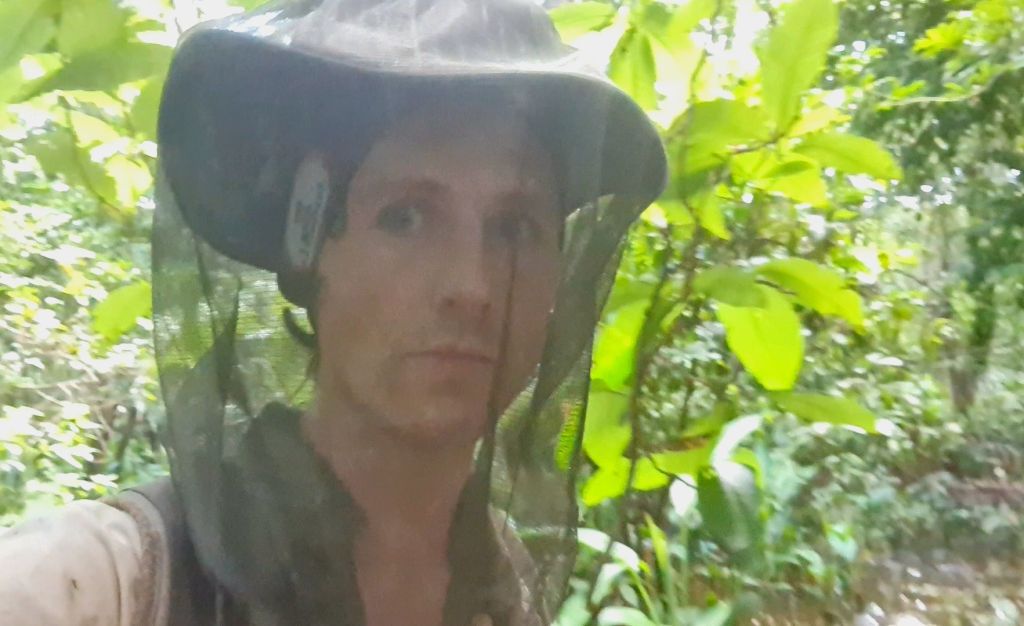
Gaia is waiting for us at the end of the trail. I have never seen a puma before. Her coat is a vibrant orange and she is notably smaller than a jaguar, though with bigger eyes it would seem. She stares curiously at the new face hidden behind a mosquito net. Adi and I lean down to say hello and she initiates affection, licking our hands and arms and sniffing around to get to know me. We then proceed to do a few laps of the enclosure. Despite being a cat that is taken on walks, her home is still massive. She loves to run and we encourage this by throwing a ball fashioned from vines parallel to the fence. After a few laps, she grows tired and takes some rest within her section of jungle. Adi and I use the time to make some new toys for her. These are to be made from foraged items in the jungle, such as vines and patujú leaves. We make some balls with cocoa inside and hang them in her management cage. We then let her in to have an explore and use this opportunity to clean her enclosure, change her water and hide her food around for her to search for, as with Kusiy. After a few hours, it is then time to say goodbye again and we begin the walk back for lunch.
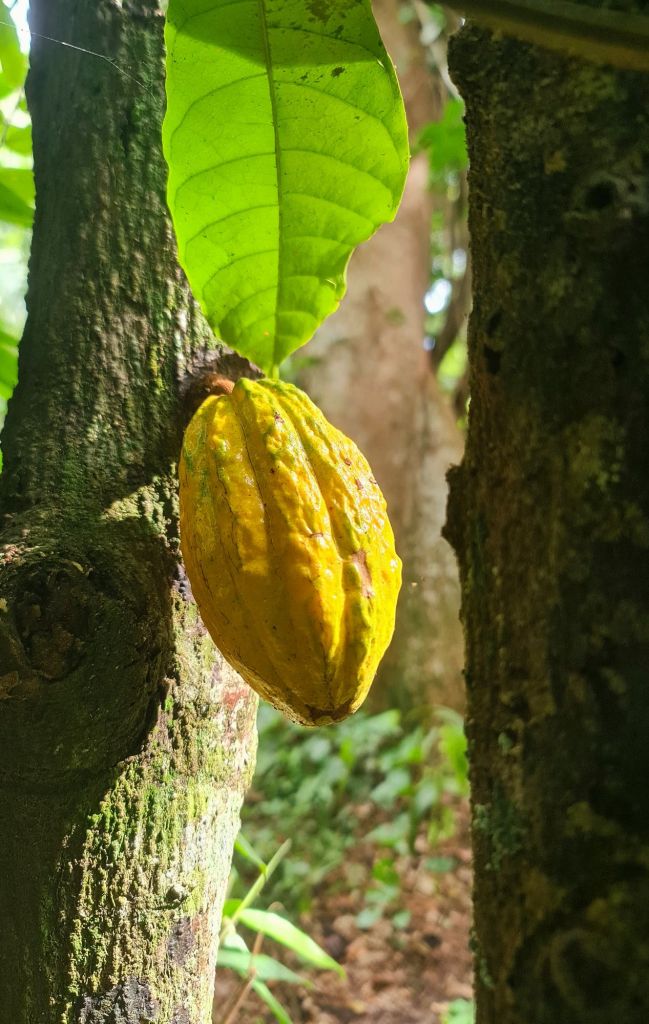
We found a nice looking cocoa pod earlier. Adi splits it in half and we snack on a piece each during the journey home. The inside is formed of small, white lumps that can be removed in turn. The fruit is the pulp, inside which lies the cocoa bean. These are used to make chocolate, but are bitter when consumed raw. One sucks off the pulp and spits out the seed (unless you are feeling brave).
We arrive back at camp and get changed. It is essential to wear different clothes for each cat, else you run the risk of bringing the smell of one feline to another. A puma does not want the scent of a jaguar turning up at their enclosure. Also, we are drenched and it is nice to put on something that is only damp instead. Not dry, but damp. This is the best one can wish for. We take lunch, and in the afternoon, with Marine still being ill, I am shown to Kusiy’s enclosure by someone else, Valérian, one of Kusiy’s previous volunteers. He suggests that I walk ahead of him to see how well I know the route after my first visit. Only somewhat well, it would seem. To be fair, upon entering the swamp on the way to the enclosure, it is quite hard to find one’s way out again.
Drenched from the waists down, we arrive at the enclosure and say hello, before spending another delightful afternoon with Kusiy and heading back to camp for the weekend.
 George's blog